At Biz Export Hub, we have been helping exporters and buyers of engineering goods and industrial machinery connect since 2015. Over the years, we have seen that one of the biggest challenges exporters face is managing export documentation correctly.
Even minor mistakes in paperwork can delay shipments, lead to customs issues, or cause payment problems. That’s why we have created this extensive guide to the top 10 essential documents required for exporting engineering goods, along with answers to almost every question exporters may have about the process.
Whether you are a seasoned exporter or a newcomer, this guide will help you navigate every step confidently and efficiently.
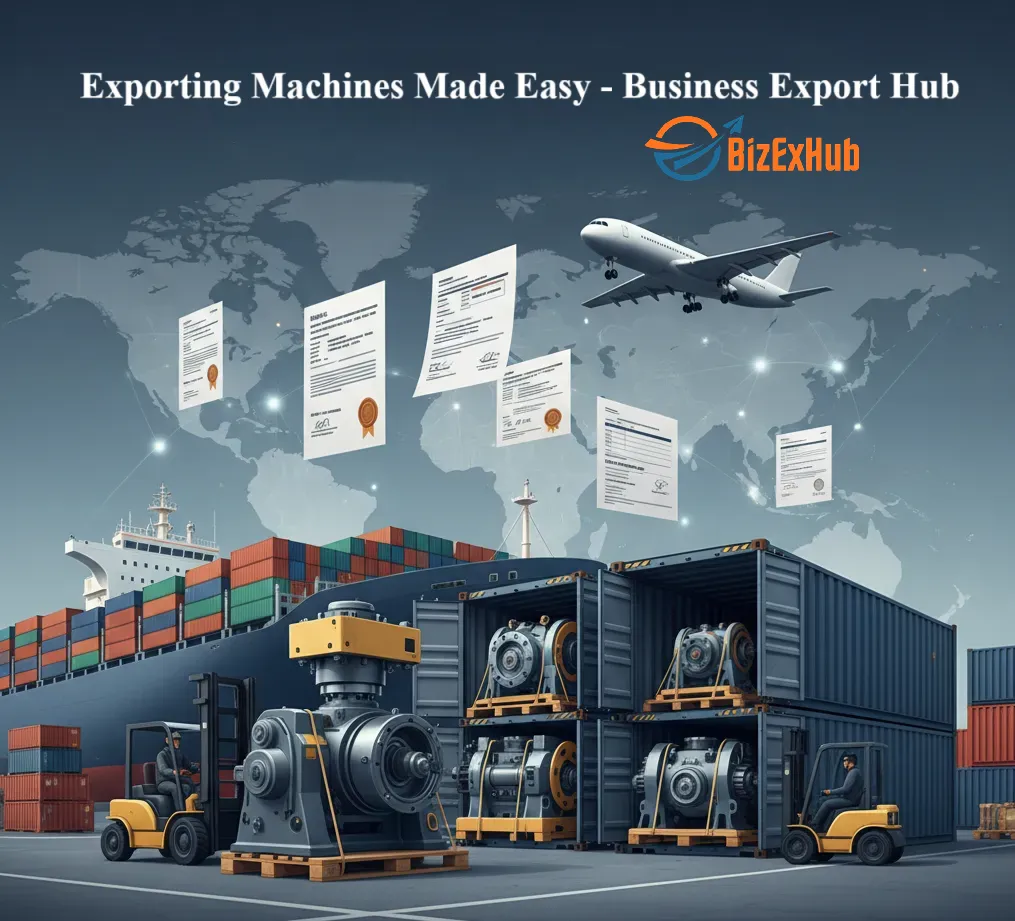
Note: This guide applies to all types of machines, including industrial, manufacturing, construction, packaging, and other engineering equipment, along with general engineering goods. Whether you are exporting heavy machinery, mechanical equipment, or precision tools, the documents listed here are applicable.
Step 1: Commercial Invoice
The Commercial Invoice is the most important export document. We always tell our exporters that it acts as a legal contract between the buyer and the seller and is used for customs clearance, taxation, and bank payments.
Key Details to Include:
-
Exporter and importer information
-
Product description and HS code
-
Quantity, unit price, and total value
-
Payment terms and Incoterms
-
Country of origin and destination
Our Tip: Since 2015, we’ve noticed that exporters who double-check invoice details across all documents face fewer delays and faster payments.
FAQ Related:
-
Q: Can one Commercial Invoice be used for multiple shipments?
A: No, each shipment requires a separate Commercial Invoice to match customs declarations.
Step 2: Packing List
We advise every exporter to prepare a detailed Packing List. This document describes the contents of each package, including weight, dimensions, and packaging type, helping customs authorities and freight forwarders verify shipments quickly.
Include:
-
Exporter and consignee details
-
Marks and numbers on packages
-
Detailed packing breakdown (carton, crate, or pallet level)
-
Gross and net weight
Our Tip: A proper packing list reduces inspection delays and helps avoid discrepancies at the destination port.
FAQ Related:
-
Q: Is the Packing List mandatory?
A: Yes, for customs clearance, especially for heavy or multiple packages.
Step 3: Bill of Lading (B/L) or Airway Bill (AWB)
The Bill of Lading (for sea shipments) or Airway Bill (for air shipments) is issued by the carrier as proof of shipment. It also serves as a document for the bank if payment is made through a Letter of Credit (LC).
Important Points:
-
Ensure consignee, product description, and weight match other documents.
-
For sea shipments, a B/L can be negotiable or non-negotiable.
Our Tip: We always recommend verifying details before shipping; mismatches between the B/L and invoice are a common cause of payment delays.
FAQ Related:
-
Q: Can I ship goods without a Bill of Lading?
A: No, the B/L or AWB is essential for customs clearance and as proof of shipment.
Step 4: Certificate of Origin (COO)
A Certificate of Origin (COO) certifies the country where goods are manufactured. Exporters use this document to allow importers to claim preferential duty rates under free trade agreements.
Obtaining a COO:
-
Issued by the Chamber of Commerce or authorized export promotion council.
-
May require supporting invoices and export documents.
Our Tip: Always check the destination country’s format requirements to avoid rejection at customs.
FAQ Related:
-
Q: Is COO mandatory for all countries?
A: Not always, but it is required for claiming preferential tariffs or under certain buyer requests.
Step 5: Shipping Bill / Export Declaration
The Shipping Bill (India) or Export Declaration (other countries) is mandatory for customs clearance. It details the exporter, HS codes, and shipment value.
Our Tip: Filing this correctly ensures smooth clearance. In India, it is filed electronically via ICEGATE.
FAQ Related:
-
Q: Can I export goods without a Shipping Bill?
A: No, customs will not release goods without this document.
Step 6: Inspection Certificate
Some buyers or countries require third-party inspection certificates to verify product quality and compliance with international standards.
Issuing Agencies: SGS, Bureau Veritas, Intertek, and others.
Our Tip: We’ve seen exporters win buyer trust and reduce disputes by providing inspection certificates proactively.
FAQ Related:
-
Q: Are inspection certificates required for all engineering goods?
A: Only if the buyer or destination country mandates it.
Step 7: Insurance Certificate
We always advise exporters to secure insurance for shipments. The Insurance Certificate confirms coverage against loss, damage, or theft during transit.
Include:
-
Policy number and insurer details
-
Type of coverage and insured amount
-
Description of goods
Our Tip: Even if terms are FOB, insurance is a safety net that protects your business.
FAQ Related:
-
Q: Is insurance mandatory for export?
A: Not legally, but it is strongly recommended to protect your shipment.
Step 8: Letter of Credit (LC) or Payment Terms Document
For secure international trade, the LC ensures payment is released only when all required documents are submitted.
Our Tip: Review LC terms carefully. Banks strictly check for document compliance.
FAQ Related:
-
Q: Can I accept advance payments instead of LC?
A: Yes, advance payments are safer for small orders or trusted buyers.
Step 9: Export License (if applicable)
Most standard engineering goods do not require an export license, but restricted items (like defense components or advanced technology machinery) do.
Our Tip: Verify your product’s classification with DGFT or your local trade authority before shipment.
FAQ Related:
-
Q: How do I know if my product requires an export license?
A: Check government export control lists or consult with your export promotion council.
Step 10: Proforma Invoice
The Proforma Invoice is a preliminary document sent to the buyer before shipment to confirm pricing, terms, and conditions. It helps buyers arrange payment or open an LC.
Our Tip: Include validity, delivery time, and Incoterms clearly to avoid disputes.
FAQ Related:
-
Q: How is a Proforma Invoice different from a Commercial Invoice?
A: Proforma Invoice is pre-shipment and non-binding; Commercial Invoice is post-shipment and legally binding.
Frequently Asked Questions (All-in-One)
General Questions:
-
Q: Why are export documents important?
A: They ensure legal compliance, smooth customs clearance, and timely payment. -
Q: Can we prepare export documents ourselves?
A: Yes, but many exporters use freight forwarders or agents for accuracy. -
Q: How long should we keep export documents?
A: At least 5 years for compliance, audits, and disputes.
Document-Specific Questions:
-
Q: Can one invoice be used for multiple shipments?
A: No, each shipment requires its own invoice. -
Q: Who issues the Certificate of Origin?
A: Usually, the Chamber of Commerce or authorized export councils. -
Q: What if documents have minor errors?
A: Even minor errors can delay customs clearance or LC payments. -
Q: Are inspection certificates mandatory?
A: Only if requested by the buyer or destination country.
Shipping & Logistics Questions:
-
Q: Can we ship goods without B/L or AWB?
A: No, they are essential for customs and payment verification. -
Q: Do we need insurance for FOB shipments?
A: While not mandatory, insurance is highly recommended. -
Q: How do Incoterms affect documents?
A: Incoterms define responsibility for shipping, insurance, and customs clearance.
Payment & Risk Questions:
-
Q: Can we accept open account payments safely?
A: Yes, with verified buyers, but risk is higher than LC or advance payments. -
Q: How does LC compliance work?
A: Banks release payment only if all documents strictly meet LC terms.
Final Thoughts
Since 2015, we have seen exporters achieve faster shipments, fewer disputes, and higher buyer trust by preparing and organizing export documents correctly.
Proper documentation not only ensures smooth customs clearance but also builds credibility with international buyers.
At Biz Export Hub, we help exporters list their products, respond to genuine inquiries, and manage all documentation effectively. Register with us today to start receiving verified inquiries for your engineering goods.